

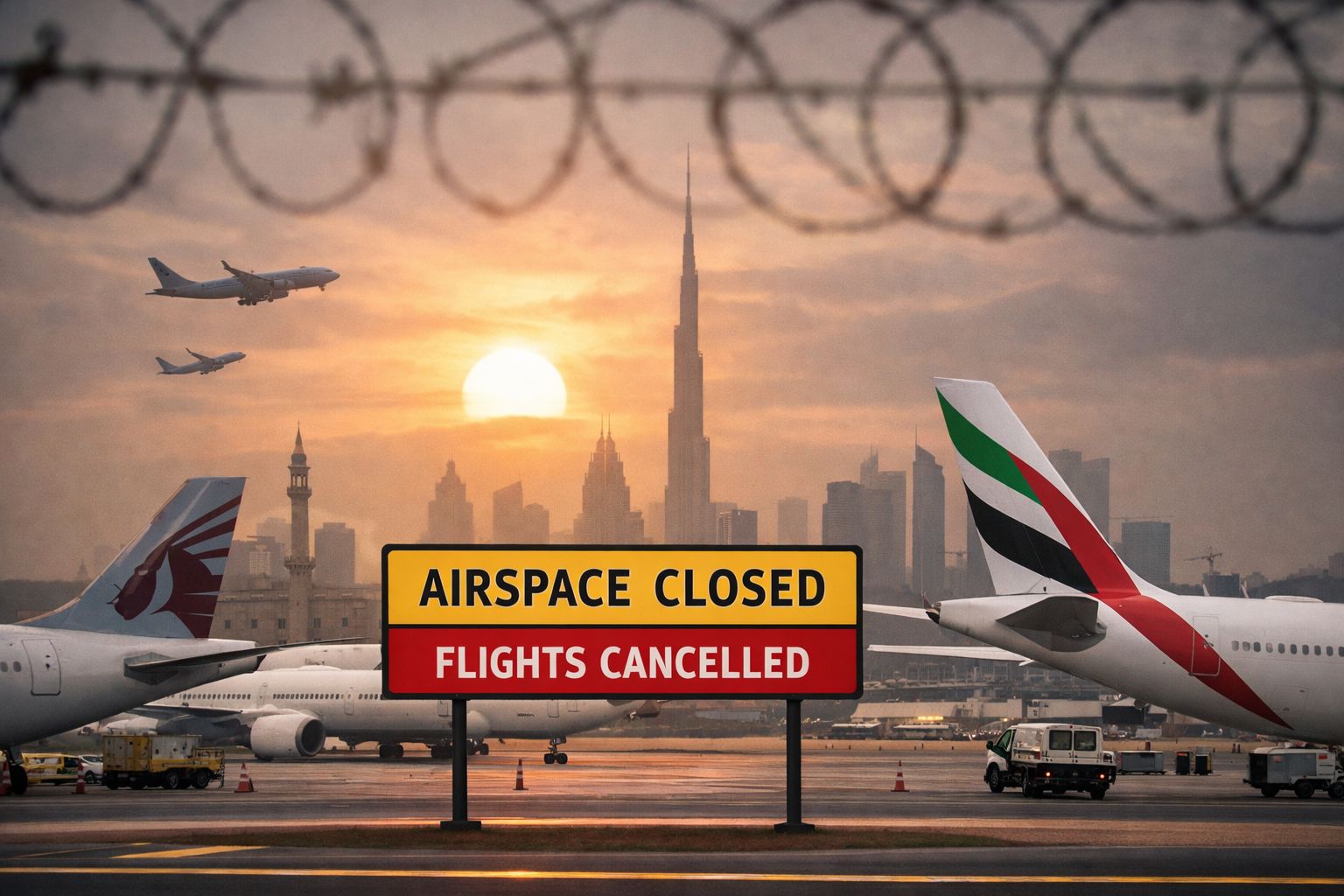
Air travel across several Middle Eastern countries continues to face major disruption due to ongoing airspace restrictions. Airports in the UAE, Qatar, Kuwait, Israel, Bahrain, Iraq, and Jordan have experienced significantly reduced flight activity, with thousands of departures and arrivals either canceled or rerouted.
Major regional airlines have suspended most commercial operations temporarily. While some limited cargo, repositioning, and repatriation flights are operating under strict government approval, regular passenger services remain heavily affected. Travelers have been advised to check directly with their airlines before heading to the airport, as flight schedules continue to change frequently.
In the United Arab Emirates, airlines have announced temporary suspension of scheduled international flights, with only limited services resuming under special permissions. In Qatar, airspace restrictions have also resulted in widespread cancellations, and airlines have stated that updates will be provided as the situation develops.
The impact is not limited to the region. Global travel networks have been disrupted, especially long-haul routes between Asia and Europe. Many airlines are now using alternative flight paths, either flying north through Central Asia or taking southern routes across parts of Africa. However, these detours increase flight time, fuel consumption, and operational costs.
According to recent aviation data, thousands of flights have been canceled in the past few days, affecting both regional and international carriers. Some airlines have extended suspensions to specific destinations while closely monitoring the situation.
When Could Airspace Reopen?
At this time, there is no confirmed date for full reopening. Airlines and aviation authorities are continuing to evaluate safety conditions and operational requirements. Flight resumption will depend on official government announcements and security assessments.